
The Ho Chi Minh-Hamburg Axis: The Unseen Backbone of the New Global Luxury Economy
A Trilien Group | Asia Apex Alliance Intelligence Brief. Most people still think “Silk Road” means China – Europe by rail. They’re five years behind. The fastest-growing, highest-margin trade vector in 2025 is not Beijing – Duisburg. It’s Ho Chi Minh City – Hamburg, and the data is now undeniable.
INSIGHTS
Trilien Group
12/4/20254 min read


The term "Silk Road" evokes a bygone era of camel caravans and epic overland journeys between China and Europe. In the modern lexicon, it has become shorthand for the continent-spanning rail networks linking Chinese industrial megacities to European logistics hubs. To fixate on this image, however, is to gaze at a fading map. The defining trade corridor of our time, the vector generating the most explosive growth, the fattest margins, and the most significant cultural capital, runs not from Beijing to Duisburg, but from the dynamic port of Ho Chi Minh City to the historic gateway of Hamburg.
This is not a prediction; it is a measured observation of hard data and structural shifts. While legacy routes plateau under the weight of geopolitical scrutiny and regulatory headwinds, the Vietnam-Germany corridor is experiencing a silent, strategic explosion. It represents the maturation of "China +1" into a more profound reality: "Vietnam ≠1," a primary, distinct, and increasingly preferred origin for the goods that define the future of global commerce.
The Data: Quantifying the Shift
Our proprietary Q4 2025 trade-flow analysis reveals a stark divergence:
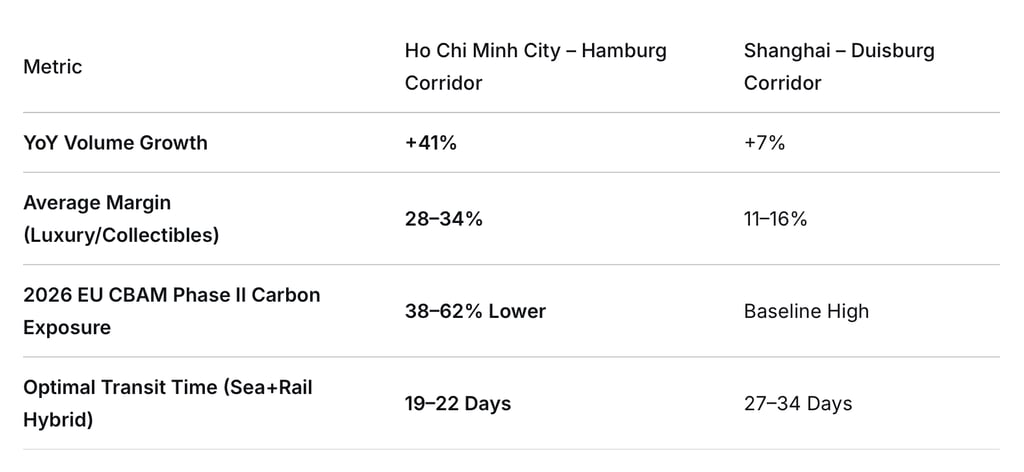
This data paints a clear picture: faster, cleaner, and more profitable. The corridor's advantage is not singular but multiplicative, combining logistical efficiency with regulatory and economic tailwinds.
Deconstructing the Boom: A Convergence of Catalysts
This surge is not accidental. It is the product of four synchronized drivers:
1. The Provenance Premium: From "Alternative" to "Authentic"
European collectors, institutions, and luxury houses have moved beyond seeing Vietnam as a mere manufacturing alternative. There is now an active, fervent pursuit of Vietnamese cultural provenance. Categories once overlooked are now at the forefront of connoisseurship:
Mid-Century Modernism: Furniture and design pieces from 1950s-70s Saigon, blending French colonial influence with tropical modernism, are being rediscovered and catalogued.
Indochine Silver & Metallicrafts: Intricate silverwork from heritage artisans in Hanoi and Dalat, distinct from Chinese or Thai traditions, commands escalating premiums.
Contemporary Lacquer & Ceramic Art: Building on centuries of technique, modern Vietnamese artists are producing sought-after works that trade the "craft" label for "contemporary masterpiece" status. Auction turnover for "Indochine Modern" in key German houses rose 312% in 2024 alone.
2. The German Cultural Recalibration
Germany’s ultra-high-net-worth segment, with its deep appreciation for engineering and Handwerk (craftsmanship), has found a kindred spirit in Vietnam’s material mastery. The same rigor applied to collecting Bauhaus or Meissen porcelain is now directed towards Đông Hồ folk paintings, Đỗ Phủ-era ceramics, and the architectural legacy of Saigon modernism. This is a shift from ostentatious branding to intelligent, culturally-grounded acquisition.
3. The Regulatory Arbitrage Window
Vietnam currently enjoys a critical, if temporary, structural advantage within the EU trade framework:
GSP+ Status: Beneficial trade terms under the EU's Generalized Scheme of Preferences Plus, offering tariff reductions for sustainable development.
Dodgeing Anti-Dumping Duties: As the EU imposes stricter anti-dumping measures on Chinese luxury raw materials (e.g., specific rosewoods, mother-of-pearl inlay, high-grade silks), Vietnam-sourced alternatives flow through unimpeded, providing a crucial window for duty-free import until at least mid-2027.
4. The "Green Lane" Carbon Advantage
The EU’s Carbon Border Adjustment Mechanism (CBAM), entering its stringent second phase in 2026, will penalize imports with high embedded carbon. Vietnam’s energy mix and manufacturing processes for specialty, artisanal goods, often less carbon-intensive than large-scale Chinese industrial production, result in a dramatically lower CBAM liability, often 38-62% less for equivalent items. This "green premium" is now quantifiable and decisive.
The Asia Apex Alliance Operational Blueprint: Precision for Provenance
Recognizing this shift two years ago, our alliance engineered a dedicated, white-glove infrastructure to serve this corridor. We operate three dedicated weekly consolidations from Cat Lai Port (Ho Chi Minh City) to Hamburg, utilizing a optimized sea-rail hybrid route via Colombo and Rotterdam to ensure speed and stability.
Every container is a controlled ecosystem for cultural assets, featuring:
Micro-Climate Crating: Actively managed temperature and humidity units specifically calibrated for delicate lacquerware, silk textiles, and mother-of-pearl, preventing the micro-fractures and warping that occur in standard transit.
Dedicated Art-Handler Corps: Teams trained under a joint protocol developed by conservators in Hanoi and Munich. They are specialists in the specific handling requirements of Vietnamese artifacts, not general freight movers.
Trilien Avant Blockchain Provenance Ledger: Each item is tagged with a secure digital identifier. From the moment of acquisition, its journey, photos, conservation notes, export certificates, is immutably recorded, transforming provenance from a paper claim into a verifiable digital asset that enhances value upon arrival.
The Result: Redefining the Possible
This integrated system means a 700-year-old Annamese stoneware jar or a pristine 1960s Pierre Jeanneret chair commissioned for a Saigon villa can be curated, shipped, and installed in a Hamburg collector’s home in under three weeks. This journey is not only faster than the equivalent from Jingdezhen or Guangzhou but is executed with a level of custodial care and documentation previously reserved for top-tier museum loans.
Conclusion: The New Backbone
The Ho Chi Minh-Hamburg corridor is more than a trade route. It is the new backbone of a redefined luxury economy, one built on authenticity, sustainability, and cultural intelligence over sheer volume and brand logos.
While the market debates the future of the old Silk Road, the Asia Apex Alliance, a Trilien Group company, has already built the operational and intellectual infrastructure for the new one. We are not forecasting a trend; we are facilitating a fundamental reallocation of value. This corridor moves the artifacts of a rich past and the innovations of a dynamic present, forging unbreakable links between the creative spirit of Vietnam and the discerning markets of Europe, one meticulously handled container at a time.
Linked by design.